 Add to Chrome
 Add to Firefox
 Add to Edge
DynFrame: Adaptive Reasoning-Driven Multimodal Framework with Dynamic Frame Augmentation for Complex Video Understanding
May 26, 2026
Recent video multimodal large language models (MLLMs) increasingly couple step-by-step reasoning with on-demand visual evidence retrieval, allowing models to revisit relevant video segments during inference. However, two structural gaps remain in existing thinking-with-video systems. (i) Sampling density is not a learnable decision: existing methods may let the model decide where to look, but the per-window frame rate is largely fixed. As a result, fine-grained evidence is often recovered through repeated retrieval calls, which increases inference context length and training difficulty. (ii) Retrieval and answer generation are usually optimized with a single trajectory-level advantage, so the "where to look" tokens and the "how to answer" tokens receive the same credit even when one is correct and the other is not. To address these gaps, we present DynFrame, a framework that emits the temporal window and the sampling density as native tokens within a single autoregressive pass. This learnable span-density retrieval enables acquiring multi-granularity evidence with a single retrieval step. Based on the above tokenized retrieval interface, we further introduce Segment-Decoupled GRPO (SD-GRPO), which splits each rollout at the retrieval boundary and assigns role-specific token-level advantages, separately crediting the sampling decision and the answer. Trained on the curated DM-CoT-74k and DM-RL-45k, DynFrame-4B is competitive with strong 7B-8B baselines across six benchmarks (NExT-GQA, Charades-STA, ActivityNet-MR, Video-MME, MLVU, LVBench), and DynFrame-8B sets new state-of-the-art on most metrics. Code is available at https://github.com/zhangguanghao523/DynFrame.

Think When Needed: Adaptive Reasoning-Driven Multimodal Embeddings with a Dual-LoRA Architecture
May 14, 2026Multimodal large language models (MLLMs) have emerged as a powerful backbone for multimodal embeddings. Recent methods introduce chain-of-thought (CoT) reasoning into the embedding pipeline to improve retrieval quality, but remain costly in both model size and inference cost. They typically employ separate reasoner and embedder with substantial parameter overhead, and generate CoT indiscriminately for every input. However, we observe that for simple inputs, discriminative embeddings already perform well, and redundant reasoning can even mislead the model, degrading performance. To address these limitations, we propose Think When Needed (TWN), a unified multimodal embedding framework with adaptive reasoning. TWN introduces a dual-LoRA architecture that attaches reasoning and embedding adapters to a shared frozen backbone, detaching gradients at their interface to mitigate gradient conflicts introduced by joint optimization while keeping parameters close to a single model. Building on this, an adaptive think mechanism uses a self-supervised routing gate to decide per input whether to generate CoT, skipping unnecessary reasoning to reduce inference overhead and even improve retrieval quality. We further explore embedding-guided RL to optimize CoT quality beyond supervised training. On the 78 tasks of MMEB-V2, TWN achieves state-of-the-art embedding quality while being substantially more efficient than existing generative methods, requiring only 3-5% additional parameters relative to the backbone and up to 50% fewer reasoning tokens compared to the full generative mode.
XEmbodied: A Foundation Model with Enhanced Geometric and Physical Cues for Large-Scale Embodied Environments
Apr 20, 2026Vision-Language-Action (VLA) models drive next-generation autonomous systems, but training them requires scalable, high-quality annotations from complex environments. Current cloud pipelines rely on generic vision-language models (VLMs) that lack geometric reasoning and domain semantics due to their 2D image-text pretraining. To address this mismatch, we propose XEmbodied, a cloud-side foundation model that endows VLMs with intrinsic 3D geometric awareness and interaction with physical cues (e.g., occupancy grids, 3D boxes). Instead of treating geometry as auxiliary input, XEmbodied integrates geometric representations via a structured 3D Adapter and distills physical signals into context tokens using an Efficient Image-Embodied Adapter. Through progressive domain curriculum and reinforcement learning post-training, XEmbodied preserves general capabilities while demonstrating robust performance across 18 public benchmarks. It significantly improves spatial reasoning, traffic semantics, embodied affordance, and out-of-distribution generalization for large-scale scenario mining and embodied VQA.
DSI-Bench: A Benchmark for Dynamic Spatial Intelligence
Oct 21, 2025Reasoning about dynamic spatial relationships is essential, as both observers and objects often move simultaneously. Although vision-language models (VLMs) and visual expertise models excel in 2D tasks and static scenarios, their ability to fully understand dynamic 3D scenarios remains limited. We introduce Dynamic Spatial Intelligence and propose DSI-Bench, a benchmark with nearly 1,000 dynamic videos and over 1,700 manually annotated questions covering nine decoupled motion patterns of observers and objects. Spatially and temporally symmetric designs reduce biases and enable systematic evaluation of models' reasoning about self-motion and object motion. Our evaluation of 14 VLMs and expert models reveals key limitations: models often conflate observer and object motion, exhibit semantic biases, and fail to accurately infer relative relationships in dynamic scenarios. Our DSI-Bench provides valuable findings and insights about the future development of general and expertise models with dynamic spatial intelligence.
CMMCoT: Enhancing Complex Multi-Image Comprehension via Multi-Modal Chain-of-Thought and Memory Augmentation
Mar 07, 2025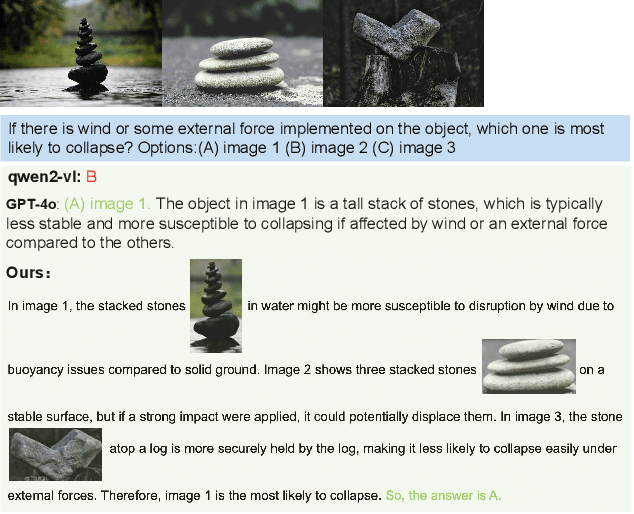


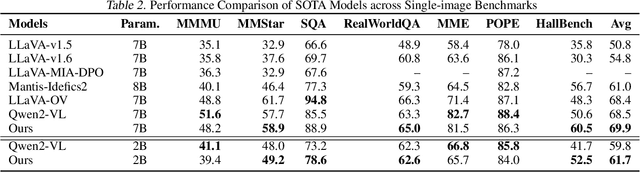
While previous multimodal slow-thinking methods have demonstrated remarkable success in single-image understanding scenarios, their effectiveness becomes fundamentally constrained when extended to more complex multi-image comprehension tasks. This limitation stems from their predominant reliance on text-based intermediate reasoning processes. While for human, when engaging in sophisticated multi-image analysis, they typically perform two complementary cognitive operations: (1) continuous cross-image visual comparison through region-of-interest matching, and (2) dynamic memorization of critical visual concepts throughout the reasoning chain. Motivated by these observations, we propose the Complex Multi-Modal Chain-of-Thought (CMMCoT) framework, a multi-step reasoning framework that mimics human-like "slow thinking" for multi-image understanding. Our approach incorporates two key innovations: 1. The construction of interleaved multimodal multi-step reasoning chains, which utilize critical visual region tokens, extracted from intermediate reasoning steps, as supervisory signals. This mechanism not only facilitates comprehensive cross-modal understanding but also enhances model interpretability. 2. The introduction of a test-time memory augmentation module that expands the model reasoning capacity during inference while preserving parameter efficiency. Furthermore, to facilitate research in this direction, we have curated a novel multi-image slow-thinking dataset. Extensive experiments demonstrate the effectiveness of our model.
MINT: Multi-modal Chain of Thought in Unified Generative Models for Enhanced Image Generation
Mar 03, 2025Unified generative models have demonstrated extraordinary performance in both text and image generation. However, they tend to underperform when generating intricate images with various interwoven conditions, which is hard to solely rely on straightforward text-to-image generation. In response to this challenge, we introduce MINT, an innovative unified generative model, empowered with native multimodal chain of thought (MCoT) for enhanced image generation for the first time. Firstly, we design Mixture of Transformer Experts (MTXpert), an expert-parallel structure that effectively supports both natural language generation (NLG) and visual capabilities, while avoiding potential modality conflicts that could hinder the full potential of each modality. Building on this, we propose an innovative MCoT training paradigm, a step-by-step approach to multimodal thinking, reasoning, and reflection specifically designed to enhance image generation. This paradigm equips MINT with nuanced, element-wise decoupled alignment and a comprehensive understanding of textual and visual components. Furthermore, it fosters advanced multimodal reasoning and self-reflection, enabling the construction of images that are firmly grounded in the logical relationships between these elements. Notably, MINT has been validated to exhibit superior performance across multiple benchmarks for text-to-image (T2I) and image-to-text (I2T) tasks.
CustomVideoX: 3D Reference Attention Driven Dynamic Adaptation for Zero-Shot Customized Video Diffusion Transformers
Feb 10, 2025Customized generation has achieved significant progress in image synthesis, yet personalized video generation remains challenging due to temporal inconsistencies and quality degradation. In this paper, we introduce CustomVideoX, an innovative framework leveraging the video diffusion transformer for personalized video generation from a reference image. CustomVideoX capitalizes on pre-trained video networks by exclusively training the LoRA parameters to extract reference features, ensuring both efficiency and adaptability. To facilitate seamless interaction between the reference image and video content, we propose 3D Reference Attention, which enables direct and simultaneous engagement of reference image features with all video frames across spatial and temporal dimensions. To mitigate the excessive influence of reference image features and textual guidance on generated video content during inference, we implement the Time-Aware Reference Attention Bias (TAB) strategy, dynamically modulating reference bias over different time steps. Additionally, we introduce the Entity Region-Aware Enhancement (ERAE) module, aligning highly activated regions of key entity tokens with reference feature injection by adjusting attention bias. To thoroughly evaluate personalized video generation, we establish a new benchmark, VideoBench, comprising over 50 objects and 100 prompts for extensive assessment. Experimental results show that CustomVideoX significantly outperforms existing methods in terms of video consistency and quality.
Development and Testing of a Wood Panels Bark Removal Equipment Based on Deep Learning
Oct 15, 2024Attempting to apply deep learning methods to wood panels bark removal equipment to enhance the quality and efficiency of bark removal is a significant and challenging endeavor. This study develops and tests a deep learning-based wood panels bark removal equipment. In accordance with the practical requirements of sawmills, a wood panels bark removal equipment equipped with a vision inspection system is designed. Based on a substantial collection of wood panel images obtained using the visual inspection system, the first general wood panels semantic segmentation dataset is constructed for training the BiSeNetV1 model employed in this study. Furthermore, the calculation methods and processes for the essential key data required in the bark removal process are presented in detail. Comparative experiments of the BiSeNetV1 model and tests of bark removal effectiveness are conducted in both laboratory and sawmill environments. The results of the comparative experiments indicate that the application of the BiSeNetV1 segmentation model is rational and feasible. The results of the bark removal effectiveness tests demonstrate a significant improvement in both the quality and efficiency of bark removal. The developed equipment fully meets the sawmill's requirements for precision and efficiency in bark removal processing.
LLaVA-MoD: Making LLaVA Tiny via MoE Knowledge Distillation
Aug 28, 2024We introduce LLaVA-MoD, a novel framework designed to enable the efficient training of small-scale Multimodal Language Models (s-MLLM) by distilling knowledge from large-scale MLLM (l-MLLM). Our approach tackles two fundamental challenges in MLLM distillation. First, we optimize the network structure of s-MLLM by integrating a sparse Mixture of Experts (MoE) architecture into the language model, striking a balance between computational efficiency and model expressiveness. Second, we propose a progressive knowledge transfer strategy to ensure comprehensive knowledge migration. This strategy begins with mimic distillation, where we minimize the Kullback-Leibler (KL) divergence between output distributions to enable the student model to emulate the teacher network's understanding. Following this, we introduce preference distillation via Direct Preference Optimization (DPO), where the key lies in treating l-MLLM as the reference model. During this phase, the s-MLLM's ability to discriminate between superior and inferior examples is significantly enhanced beyond l-MLLM, leading to a better student that surpasses its teacher, particularly in hallucination benchmarks. Extensive experiments demonstrate that LLaVA-MoD outperforms existing models across various multimodal benchmarks while maintaining a minimal number of activated parameters and low computational costs. Remarkably, LLaVA-MoD, with only 2B activated parameters, surpasses Qwen-VL-Chat-7B by an average of 8.8% across benchmarks, using merely 0.3% of the training data and 23% trainable parameters. These results underscore LLaVA-MoD's ability to effectively distill comprehensive knowledge from its teacher model, paving the way for the development of more efficient MLLMs. The code will be available on: https://github.com/shufangxun/LLaVA-MoD.
WPS-Dataset: A benchmark for wood plate segmentation in bark removal processing
Apr 17, 2024
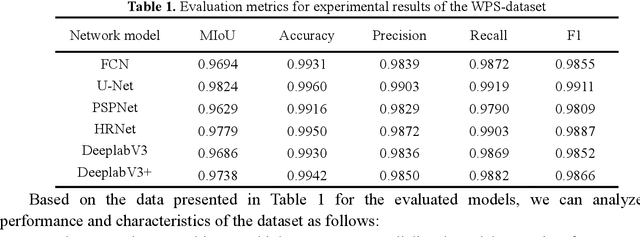


Using deep learning methods is a promising approach to improving bark removal efficiency and enhancing the quality of wood products. However, the lack of publicly available datasets for wood plate segmentation in bark removal processing poses challenges for researchers in this field. To address this issue, a benchmark for wood plate segmentation in bark removal processing named WPS-dataset is proposed in this study, which consists of 4863 images. We designed an image acquisition device and assembled it on a bark removal equipment to capture images in real industrial settings. We evaluated the WPS-dataset using six typical segmentation models. The models effectively learn and understand the WPS-dataset characteristics during training, resulting in high performance and accuracy in wood plate segmentation tasks. We believe that our dataset can lay a solid foundation for future research in bark removal processing and contribute to advancements in this field.